
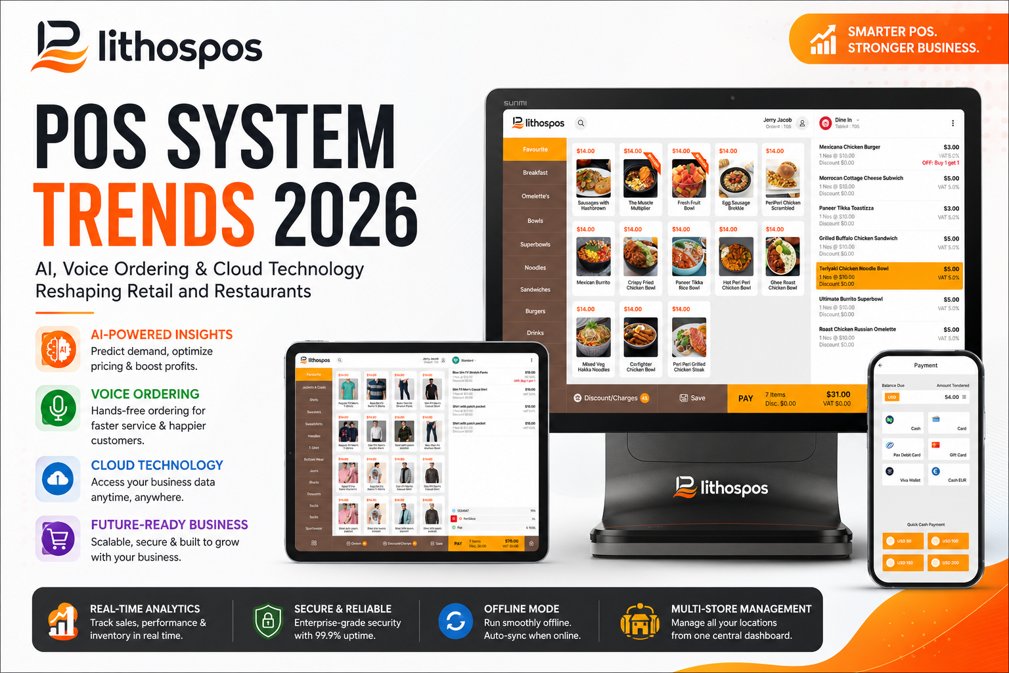
The point-of-sale (POS) system is no longer just a cash register. In 2026, the best POS systems act as the central nervous system of modern retail stores and restaurants – managing inventory, analyzing customer behavior, processing omnichannel orders, and even predicting tomorrow’s sales.
Whether you run a quick-service restaurant (QSR), a fine-dining establishment, a grocery chain, or a retail boutique, the POS system you choose in 2026 directly impacts your revenue, efficiency, and customer experience.
In this comprehensive guide, we break down the top 7 POS system trends for 2026, backed by industry data, and show you exactly how modern platforms like LithosPOS are leading this transformation.
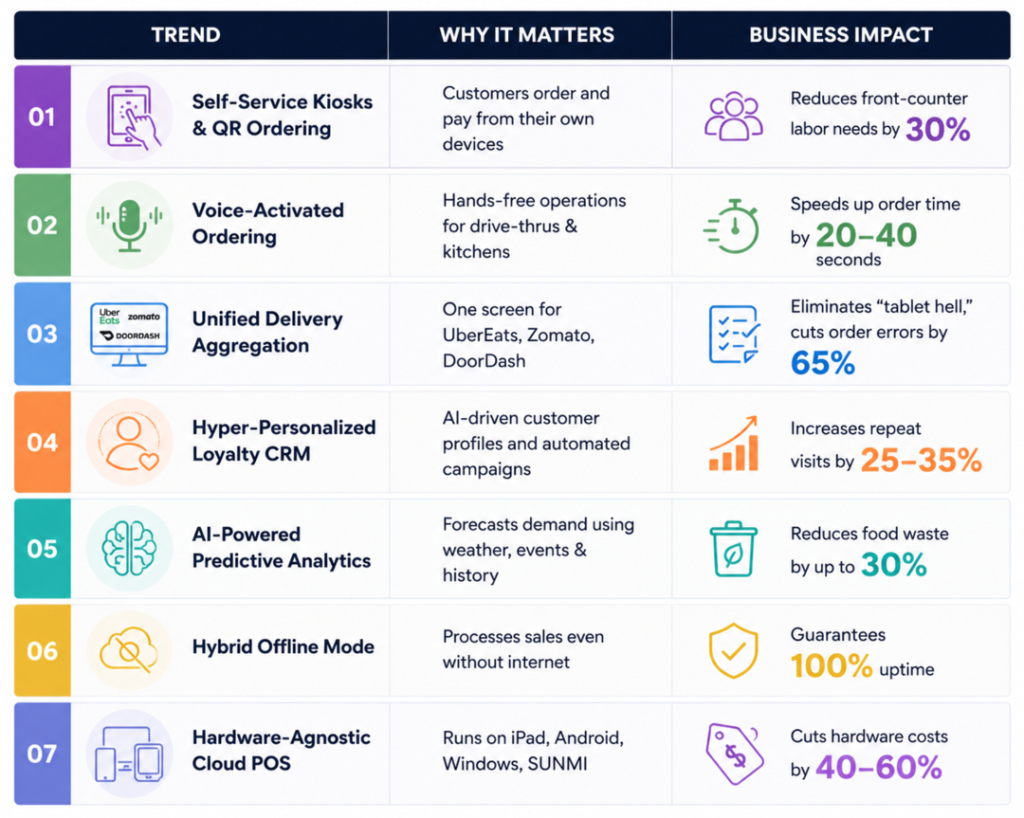
What Are the Biggest POS System Trends for 2026?
The global point-of-sale terminal market is projected to reach $181.1 billion by 2030, growing at a CAGR of 9.9% (Grand View Research). This explosive growth is fueled by seven key technology shifts that are redefining what a POS system can do.
Here are the top POS trends every business owner needs to know in 2026:
1. AI-Powered POS Systems: From Data Collection to Predictive Action
How is AI changing POS systems in 2026?
Short answer: AI transforms your POS from a system that tells you what happened yesterday into one that tells you what will happen tomorrow and automatically takes action.
In 2026, the best AI-powered POS systems analyze massive datasets combining your historical sales, external factors like weather forecasts, local events, public holidays, and even social media trends to deliver predictive insights in real time.
According to Juniper Research, AI-driven automation in retail will save businesses over $340 billion annually by 2028 through smarter inventory management and dynamic pricing.
How AI-Powered POS Helps Restaurants
Imagine your restaurant POS system automatically alerting your kitchen manager:
“Cold front expected this Saturday. Based on last year’s data, soup and hot beverage orders increased by 22%. Recommend prepping 20% extra.”
AI also enables dynamic menu pricing, slightly adjusting prices during peak and off-peak hours based on real-time demand, similar to how ride-sharing apps operate.
How AI-Powered POS Helps Retail
For retail businesses, AI solves the two biggest profit killers: stockouts and dead stock.
- Stockout Prevention: The POS automatically generates purchase orders when inventory drops below a predicted threshold, not a static reorder point, but a dynamic one based on seasonal demand curves.
- Dead Stock Reduction: AI flags slow-moving products early and suggests targeted discount campaigns before items become total losses.
How LithosPOS Uses AI
LithosPOS leverages advanced analytics and smart dashboard reporting to deliver actionable, real-time insights. From automated low-stock alerts to sales trend forecasting across multiple store locations, LithosPOS ensures your inventory is always optimized without the manual guesswork.
2. Voice-Activated POS: Conversational Commerce Enters the Kitchen
What is voice ordering in POS systems?
Short answer: Voice-activated POS technology allows restaurant staff and customers to place orders, check inventory, and manage operations using natural speech, with no screen tapping required.
We already talk to Alexa and Siri at home. In 2026, voice AI is making a massive leap into commercial POS environments.
Voice AI in Drive-Thrus and Quick-Service Restaurants
Quick-service restaurant (QSR) chains are rapidly deploying conversational AI bots at drive-thru windows.
These systems:
- Take orders accurately through natural language processing (NLP)
- Perfectly execute upselling prompts: “Would you like to add a medium fry for just $1.50 more?”
- Never forget an order modification
- Pass completed tickets directly to the Kitchen Display System (KDS) in under 2 seconds
According to PYMNTS.com, drive-thru voice AI reduces average order time by 20-40 seconds per car, translating to significantly higher throughput during peak hours.
Hands-Free Staff Operations
In busy restaurant kitchens and retail stockrooms, staff can now:
- Check real-time inventory levels by voice
- Update order statuses hands-free
- Clock in and out without touching a screen
- Call up customer profiles during table-side service
This reduces screen dependency, speeds up operations, and improves hygiene, a growing priority in food service according to the National Restaurant Association.
3. Unified Delivery Aggregation: The End of “Tablet Hell.”
What is tablet hell in restaurants?
Short answer: “Tablet hell” refers to restaurants juggling 3-5 separate tablets for different delivery platforms (Uber Eats, DoorDash, Zomato, Grubhub, and more), each with its own interface, alert sounds, and manual order re-entry leading to errors, delays, and chaos.
In 2026, omnichannel POS integration is no longer a luxury feature. It is a baseline requirement for any serious restaurant or retail operation.
How Modern POS Systems Solve Tablet Hell
The best restaurant POS systems in 2026 feature direct API integrations with all major third-party delivery platforms.
Here is how it works:
- A customer orders through Uber Eats, DoorDash, or Zomato
- The order bypasses the front counter entirely
- It flows directly into the POS and prints on the KDS
- Kitchen staff prepare it just like a dine-in order, no manual re-entry
A McKinsey & Company report found that restaurants using unified order management reduce order errors by up to 65% and increase delivery throughput by 30%.
Centralized Menu Management
When you run out of avocado or a seasonal item, you update it once in your POS. The change instantly syncs across all connected delivery platforms, your website, and your self-service kiosks. No more logging into four different dashboards.
How LithosPOS Solves Tablet Hell
LithosPOS connects your business to 50+ integrations from delivery aggregators (Uber Eats, Zomato, Talabat, Deliveroo) to enterprise accounting platforms (SAP, Oracle, Zoho Books) and local payment gateways. Every order, from every channel, arrives on one single screen.
4. Hardware-Agnostic Cloud POS: The End of Vendor Lock-In
What is a hardware-agnostic POS system?
Short answer: A hardware-agnostic POS is software that runs on any device, iPads, Android tablets, Windows PCs, or industry-specific hardware like SUNMI and PAX, without requiring proprietary equipment from the POS vendor.
For decades, legacy POS companies forced merchants into buying their expensive, proprietary hardware. If a screen broke, you had to order their specific $1,500 replacement. If you wanted to open a new location, hardware costs could run into tens of thousands of dollars.
Why Hardware-Agnostic POS Matters in 2026
The biggest shift in the point-of-sale industry in 2026 is the widespread demand for Bring Your Own Device (BYOD) capability. According to Statista, cloud POS adoption has grown by over 300% since 2020, driven primarily by small businesses seeking affordable alternatives to proprietary terminals.
How LithosPOS Delivers Hardware Freedom
LithosPOS is 100% hardware-agnostic. Run our software on the Apple iPad, any Android tablet, a Windows desktop, or specialized restaurant hardware like SUNMI devices. You get enterprise-grade POS performance without the enterprise-grade price tag, giving you absolute freedom to scale without hardware lock-in.
5. Hyper-Personalized Loyalty Programs and CRM
How do modern POS systems handle customer loyalty?
Short answer: In 2026, the best POS systems include built-in Customer Relationship Management (CRM) tools that create detailed customer profiles, track purchase history, and trigger automated, hyper-personalized marketing campaigns, replacing generic punch cards forever.
The era of “buy 10, get 1 free” punch cards is over. Today’s consumers expect businesses to know them.
What Hyper-Personalized Loyalty Looks Like
When a regular customer walks into your coffee shop or logs into your digital ordering app, your POS should instantly pull up their profile:
“Hi Sarah, your usual iced oat milk latte? You’ve earned a $5 reward want to apply it today?”
This level of recognition builds emotional loyalty, not just transactional loyalty.
Automated Retention Marketing
Modern POS-integrated CRM tracks exactly what a customer buys and when.
Powerful automations include:
- Predictive Reorder Reminders: If a customer buys pet food every 4 weeks, the system sends an SMS reminder at week 3 with a 10% discount code.
- Lapsed Customer Win-Back: If a regular hasn’t visited in 30 days, trigger an automated email with a personalized offer on their favorite items.
- Birthday and Anniversary Rewards: Automatic special offers on key dates.
- Tiered VIP Programs: Customers automatically level up based on spending, unlocking exclusive perks.
According to Bain & Company, increasing customer retention by just 5% can boost profits by 25-95%. A POS with built-in CRM is the most direct path to achieving this.
6. Hybrid Offline Mode: Zero Downtime, Zero Excuses
What happens when a cloud POS loses internet?
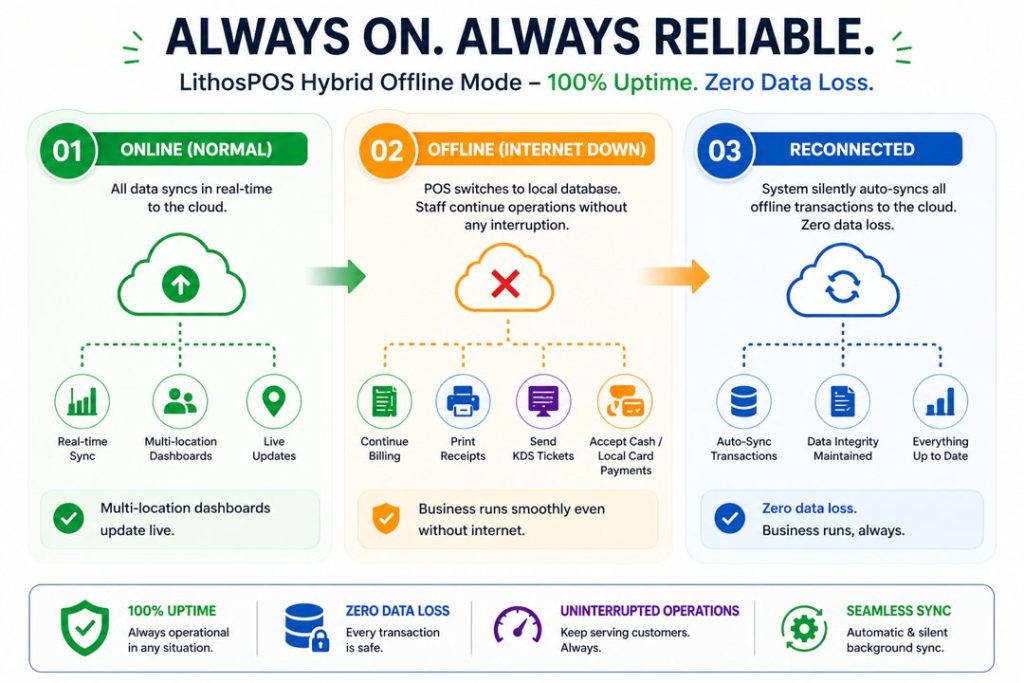
Short answer: With a hybrid offline POS, nothing happens — business continues as normal. The system processes sales, prints receipts, and sends orders to the kitchen using a local database. When the internet returns, everything auto-syncs to the cloud.
As the industry shifted to cloud-based POS systems, a critical vulnerability emerged: internet dependency. For a busy retail store or a packed Friday-night restaurant, an internet outage used to mean a complete business shutdown.
In 2026, businesses refuse to accept downtime. The industry standard is now the Hybrid Offline Mode.
How Hybrid Offline POS Works
Why This Matters for Global Businesses
For businesses operating in regions with inconsistent internet infrastructure, such as Southeast Asia, the Middle East, Africa, island nations, and developing markets, a hybrid offline capability is not a feature. It is a survival requirement. The World Bank Digital Development reports that over 2.7 billion people still lack reliable broadband, making offline-capable systems essential for global commerce.
How LithosPOS Guarantees Uptime
LithosPOS was purpose-built with island and developing-market infrastructure in mind. Our Hybrid Offline Mode guarantees 100% operational uptime. Your staff can open the cash drawer, print receipts, process orders, and send tickets to the KDS even with zero internet. The moment connectivity returns, all data syncs seamlessly. Your business never stops, even when your internet provider does.
7. Self-Service Kiosks and QR Code Mobile Ordering
What is self-service ordering in restaurants and retail?
Short answer: Self-service ordering allows customers to browse menus or product catalogs, place orders, and complete payments entirely on their own using in-store kiosks, their own smartphones via QR codes, or mobile apps without waiting for staff assistance.
The self-service revolution that began in major fast-food chains has now reached mid-sized restaurants, boutique retail stores, and grocery chains. Customers in 2026 prioritize speed and control over their ordering experience.
Self-Checkout in Retail
More retail stores, from boutiques to grocery chains, are deploying tablet-based self-checkout kiosks that require minimal staff intervention. Combined with AI-assisted cameras for loss prevention, these kiosks deliver a fast, frictionless checkout experience. According to RBR Data Services, the number of self-checkout terminals globally is expected to exceed 2 million units by 2027.
QR Code 2.0: Interactive Mobile Ordering for Restaurants
The static PDF QR code menus from the pandemic era have evolved into fully interactive digital ordering experiences:
- The customer sits down and scans the QR code on the table
- A rich, visual menu loads on their smartphone (no app download required)
- They browse, customize, and send their order directly to the bar or kitchen
- They pay using Apple Pay, Google Wallet, or any digital payment method 5. The entire experience happens without waiting for a server
- The entire experience happens without waiting for a server
Does Self-Service Replace Staff?
No. Self-service doesn’t eliminate hospitality; it enhances it. By offloading transactional tasks (taking orders, processing payments) to the customer, your team is freed to focus on what humans do best: providing exceptional service, upselling, and managing the floor. Harvard Business Review research confirms that businesses combining self-service technology with attentive human staff report the highest customer satisfaction scores.
Frequently Asked Questions (FAQ)
What is the best POS system for restaurants in 2026?
The best restaurant POS system in 2026 should offer AI-powered analytics, unified delivery aggregation (Uber Eats, DoorDash, Zomato on one screen), a Kitchen Display System, hybrid offline mode, and hardware-agnostic deployment. LithosPOS checks all these boxes and supports 50+ integrations out of the box.
How does the free trial of LithosPOS work?
You can try all Lithospos’s features free for 14 days. There’s no commitment. We won’t ask for your credit card or payment information.
Can a POS system work without internet?
Yes. Modern hybrid POS systems like LithosPOS operate on a dual architecture, cloud-first with a robust local database. If the internet drops, you continue processing sales, printing receipts, and managing orders. All data auto-syncs when connectivity returns. Learn more about LithosPOS offline mode.
What is the difference between a cloud POS and a legacy POS?
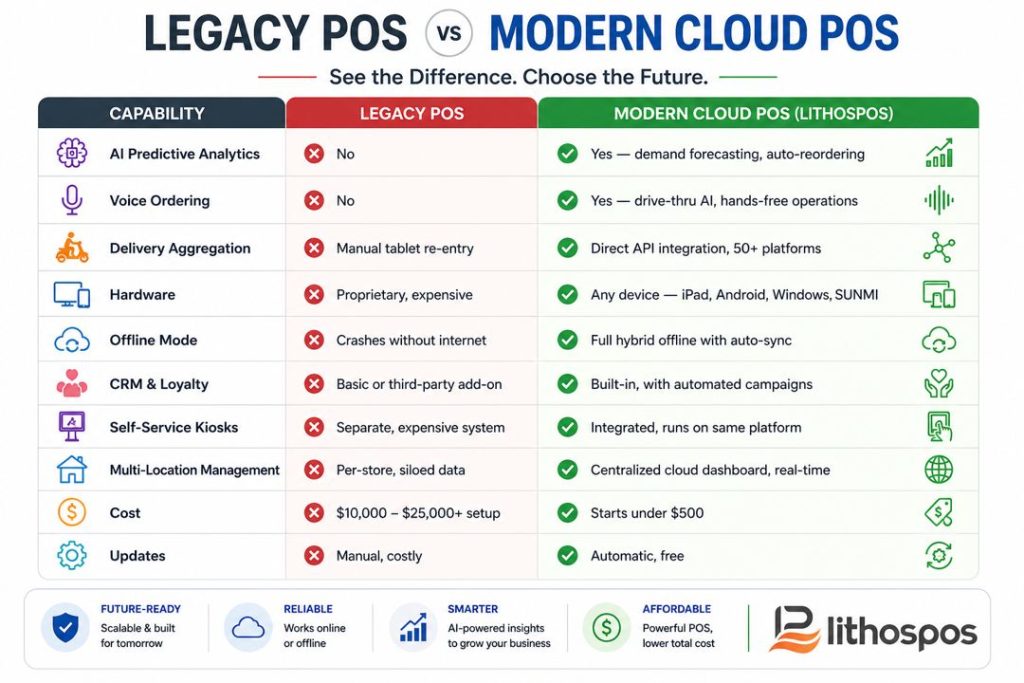
A legacy POS stores data locally on proprietary hardware, requires manual updates, and cannot integrate easily with delivery platforms or modern payment methods. A cloud POS like LithosPOS stores data in the cloud, updates automatically, runs on any device, and integrates with 50+ third-party platforms, including delivery apps, accounting software, and payment gateways.
Is voice ordering the future of POS?
Voice ordering is one of the fastest-growing POS trends in 2026, especially in drive-thru and quick-service environments. AI-powered voice bots reduce order time by 20-40 seconds per transaction and improve upselling consistency. Gartner predicts that by 2028, over 30% of all QSR orders will involve some form of voice AI assistance.
What is a hardware-agnostic POS?
A hardware-agnostic POS is software that runs on any device, iPads, Android tablets, Windows PCs, or industry hardware like SUNMI and PAX, without requiring proprietary equipment. This gives business owners the freedom to use affordable, off-the-shelf devices instead of expensive vendor-locked terminals.
Conclusion: Is Your Business Ready for the Future of POS?
The point-of-sale industry in 2026 has moved from transactional to transformational. AI predictive analytics, voice ordering, hardware freedom, hybrid offline reliability, and omnichannel delivery integration all point toward one goal: making your business faster, more resilient, and more profitable.
If your current POS system forces you into expensive hardware, crashes when the internet drops, or requires manual order re-entry from delivery tablets, you are losing money every single day.
It is time to upgrade.
LithosPOS is a cloud-based, hardware-agnostic POS platform purpose-built for modern retail and restaurant businesses across 40+ countries. With true Hybrid Offline Mode, AI-powered analytics, 50+ integrations, and deployment on any device, LithosPOS gives you the power of tomorrow – today.
Ready to future-proof your business?
Book a Free Demo with LithosPOS and see how 50,000+ businesses worldwide are already running on the future of point-of-sale technology.